Navigating Capital Entry in Ethiopia: The #1 Legal & Operational Mistake Foreign Investors Make
Ethiopia represents one of Africa’s most dynamic markets, offering immense opportunities across manufacturing, agriculture, technology, capital markets, and commercial infrastructure. However, international corporations, joint venture partners, and diaspora investors frequently encounter significant operational friction during market entry.
The main mistake foreign investors make in Ethiopia is expecting standard western market mechanics to apply. Ignoring Ethiopia’s legal framework often leads to severe liquidity bottlenecks, capital locking, and regulatory delays.
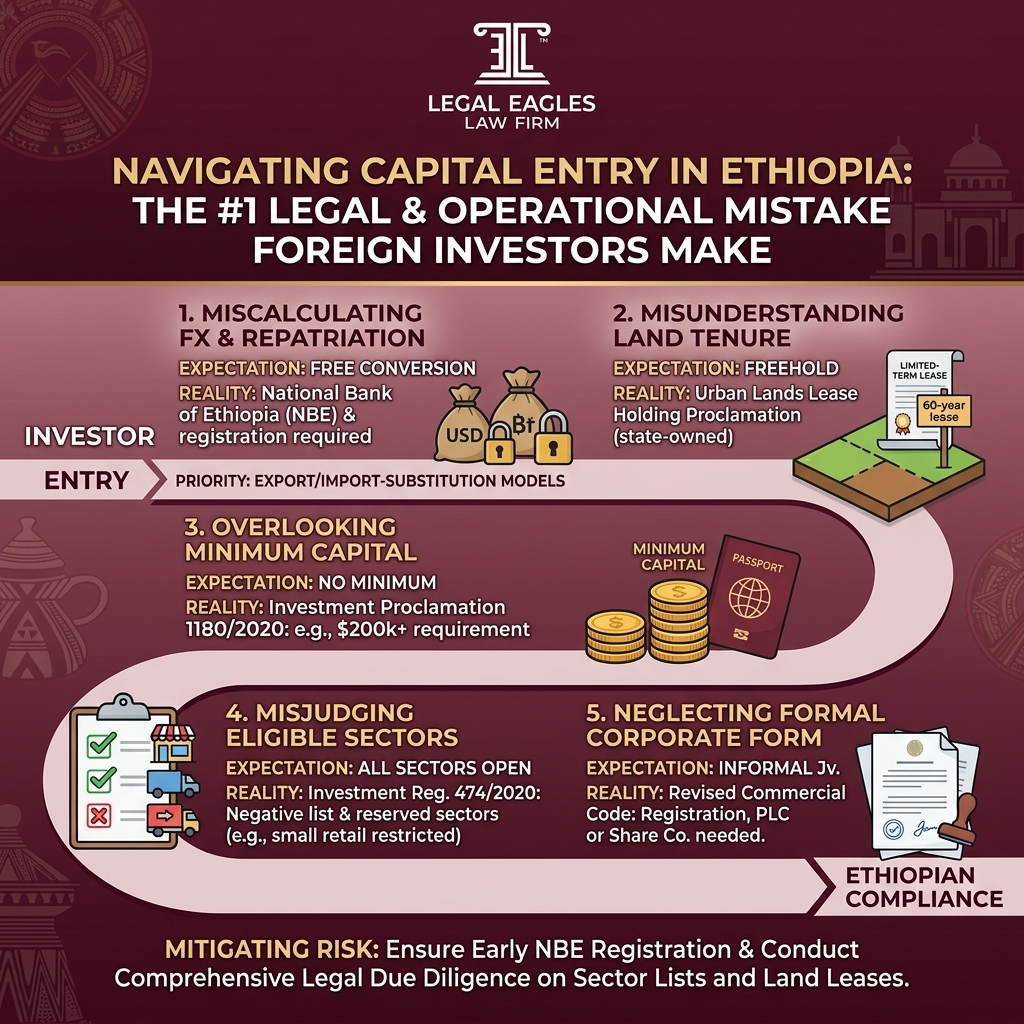
1. Miscalculating Foreign Exchange (FX) Regulations & Capital Repatriation
The primary point of friction for foreign capital entering Ethiopia lies in cross-border currency flows. Foreign investors often deploy USD or EUR expecting seamless profit conversion and dividend repatriation in Birr.
The Statutory & Policy Framework
Despite recent macroeconomic reforms, the National Bank of Ethiopia still maintains strict oversight over foreign exchange.
Under Article 20 of Investment Proclamation No. 1180/2020, foreign investors have statutory repatriation rights for:
- Net profits and dividends derived from the investment;
- Principal and interest payments on foreign loans secured in accordance with NBE directives;
- Proceeds from the liquidation or transfer of enterprise assets;
- Payments arising from technology transfer agreements registered with the Ethiopian Investment Commission (EIC).
Critical Compliance Requirement: Foreign loans and technology agreements must be pre-registered with the NBE and EIC. Failure to obtain prior registration forfeits the legal guarantee for future hard currency repatriation.
Strategic Mitigation
Investors must structure project finances with a clear understanding of domestic sourcing versus foreign currency requirements. Prioritizing export-generating ventures, utilizing import-substitution models, or securing compliant offshore debt structures are critical risk-mitigation strategies.
2. Misunderstanding Land Tenure & Real Estate Ownership Limits
A common legal error made by foreign investors is attempting to acquire full private title (“freehold”) to real estate or industrial land for operational facilities.
The Constitutional & Leasehold Regime
Under Article 40(3) of the Ethiopian Constitution, land ownership belongs exclusively to the State and its people. Land is a common property that cannot be bought, sold, or mortgaged.
Land acquisition for commercial or industrial use is strictly governed by the Urban Lands Lease Holding Proclamation No. 721/2011 and regional land administration regulations:
- State Ownership (Const. Art. 40): Land belongs to the state; investors acquire Leasehold Rights for fixed periods rather than private land ownership.
- Industrial & Commercial Tenure (Proc. No. 721/2011): Industrial lease periods are granted for fixed terms, typically lasting between 60 to 80 years.
- Structure & Development Rights: Investors maintain private ownership rights over physical developments, buildings, and infrastructure erected on the leased land.
Strategic Mitigation
Investors should verify lease terms and encumbrances directly with regional land administration bureaus or municipal cadaster offices.
3. Overlooking Sector Eligibility & Minimum Foreign Capital Thresholds
Investors often create business plans only to discover that foreign participation in their sector is restricted.
Legal Entry Requirements
Foreign investors face minimum capital requirements under Investment Regulation No. 474/2020 and Proclamation No. 1180/2020:
- Sole Foreign Investor: Minimum foreign capital investment of USD 200,000 per project.
- Joint Venture with Domestic Partner: Minimum foreign capital investment of USD 150,000 per project.
- Architectural or Engineering Consultancy: Minimum foreign capital investment of USD 100,000 (sole foreign) or USD 50,000 (joint venture).
Sector Restrictions: Certain sectors, such as small retail and local transport, remain strictly reserved for domestic investors and diaspora.
4. Misjudging Corporate Structuring Under the Commercial Code
Foreign entities often attempt informal joint ventures without registering a formal, recognized legal corporate vehicle.
The Commercial Vehicle Framework
Cross-border business activities must be structured through recognized corporate vehicles under the revised Commercial Code:
- Private Limited Company (PLC): Ideal for closely held investments, limiting liability to capital contributions.
- Share Company (S.C.): Required for larger enterprise structures, public equity offerings, or banking/insurance entities.
- Branch of a Foreign Company: Permitted under restricted statutory conditions for specific project execution.
Unregistered informal joint ventures fail to afford limited liability protection or statutory capital repatriation rights under the Commercial Code.
5. Administrative Timelines & Multi-Agency Compliance
A final operational oversight is underestimating the sequential nature of corporate licensing and regulatory compliance across multiple government bodies. Investors must plan for sequential onboarding involving:
- Ethiopian Investment Commission (EIC): Issuance of Investment Permit and evaluation of business plans.
- Ministry of Trade and Regional Integration (MOTRI): Commercial registration and trade name reservation under Proclamation No. 980/2016.
- Ministry of Revenue (MoR): Tax Identification Number (TIN) issuance and registration for Value Added Tax under VAT Proclamation No. 1341/2024.
- Commercial Bank of Ethiopia / Authorized Banks: Foreign capital registration and bank account opening.
Key Legal Takeaways for Investors
- Pre-Register Inflows: Always register initial foreign capital and debt with the NBE and EIC immediately upon entry.
- Verify Land Titles: Confirm leasehold terms and cadaster records with local municipal bureaus before acquiring commercial property.
- Verify Sector Lists: Check Investment Regulation No. 474/2020 to verify that your target sector accepts foreign capital investment.
- Formalize Entities: Structure operations through a PLC or Share Company under Proclamation No. 1243/2021 rather than informal contracts.