Beyond Government Oversight: How Ethiopia’s Ombudsman Mandate Extended to Private Business
In Ethiopia’s administrative setup, public accountability relies heavily on two primary national institutions: the Ethiopian Human Rights Commission (EHRC), tasked with protecting fundamental human rights, and the Ethiopian Institution of the Ombudsman (EIO), which ensures fair administrative practices.
Although lawmakers originally established the Ombudsman to prevent state agencies from mistreating citizens, sweeping legal updates in 2019 and 2023 transformed its authority. Most notably, the institution can now step into the private sector to investigate maladministration in commercial enterprises.
Here is an overview of how the Ombudsman operates today, what powers it holds, and where its limits lie.
1. The Legal Evolution: From 2000 to 2023
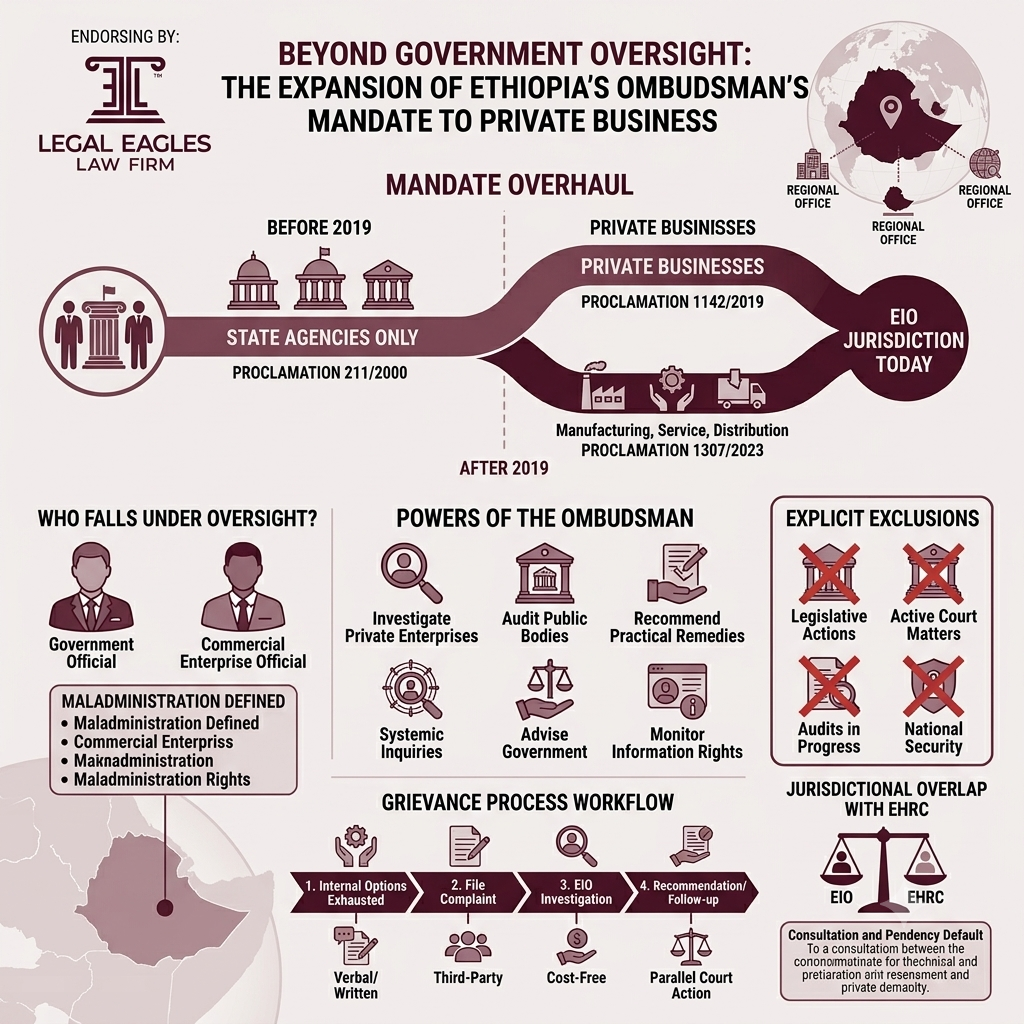
The Ombudsman’s authority has evolved through three distinct pieces of legislation enacted under Article 55 of the FDRE Constitution:
- Proclamation No. 211/2000 (The Foundation): Created the original Ombudsman structure focused strictly on public sector accountability.
- Proclamation No. 1142/2019 (The Overhaul): Repealed the 2000 law to grant the Ombudsman greater operational independence and streamline its legal structure.
- Proclamation No. 1307/2023 (The Expansion): Added commercial businesses to the EIO’s jurisdiction and emphasized maintaining industrial peace.
Organizationally, the Ombudsman remains an independent federal entity reporting directly to the House of People’s Representatives (HPR). It operates out of its headquarters in Addis Ababa alongside regional offices established across the country.
2. A Shift in Objective: Entering the Private Sector
The core mandate of the Ombudsman saw a significant policy shift in 2023. Under Article 6 of the amended Proclamation, the law tasks the institution with fostering good governance, transparency, and industrial peace rooted in the rule of law.
Crucially, the updated law requires both government executive bodies and private commercial organizations to respect statutory rights and benefits.
3.Who Falls Under Oversight?
The law applies to acts of maladministration committed by public agencies, private enterprises, and their officials.
- Private Organizations Defined: The 2023 amendment explicitly references commercial entities under Article 174(5) and (6) of the Commercial Code of Ethiopia (Proclamation No. 1243/2021). This includes businesses involved in manufacturing, services, distribution, and related commercial activities.
- Maladministration Defined: Any illegal decision, rule, administrative action—or failure to carry out a lawful requirement—by government executive bodies, public enterprises, or private businesses.
4. Key Powers of the Ombudsman
Article 7 sets out the functions of the Institution, enabling it to act as both an investigator and an advisory body:
- Private Enterprise Investigations: Receive and investigate complaints regarding administrative misconduct or unfair practices within private companies.
- Government Supervision: Audit administrative directives and decisions by public bodies to ensure compliance with the Constitution and federal legislation.
- Remedial Action and Follow-Up: Recommend practical remedies when maladministration occurs and actively track implementation.
- Systemic Inquiries: Launch investigations on its own initiative or in response to public complaints regarding wide-scale administrative issues.
- Policy Reform: Advise the government on governance standards and recommend updates or amendments to existing laws and regulations.
- Information Rights: Monitor and evaluate how public bodies fulfill their duties under Access to Information laws.
5. Explicit Exclusions: Where the Ombudsman Cannot Intervene
To respect institutional boundaries, Article 9 bars the Ombudsman from investigating four specific areas:
- Legislative Actions: Laws or formal decisions passed by elected legislative councils.
- Active Court Matters: Decisions or active cases managed by courts of law or quasi-judicial bodies.
- Audits in Progress: Cases that the Federal or Regional Auditor-General is investigating or reviewing.
- National Security: Decisions made by military or police forces concerning national defense and security.
Note: These exceptions depend on where the matter is actively being handled rather than just the underlying topic.
6. How the Grievance Process Works
For citizens, employees, or organizations considering a complaint, the law establishes specific rules under Articles 26 and 27:
- Requirement of Last Resort: Individuals must first seek relief directly from the agency or private company involved.The Ombudsman generally considers a complaint valid only after the complainant exhausts or receives no response to internal options.
- Filing Options: Complainants can submit complaints verbally, in writing, or in any regional working language, attaching supporting evidence where available.
- Third-Party Filings: Relatives, legal representatives, trade union leaders, or civil society organizations can submit complaints on behalf of an affected person.
- Anonymous Submissions: Accepted at the EIO’s discretion for severe instances of maladministration.
- Cost: The process is completely free of charge.
- Parallel Litigation: Filing a complaint with the Ombudsman does not restrict a person’s right to pursue civil or criminal court actions over the same issue.
7. Handling Overlap with the Human Rights Commission
When an administrative grievance also touches on broad human rights concerns, Article 34 outlines how the Ombudsman and the Human Rights Commission manage shared jurisdiction:
- Direct Consultation: Both entities confer to determine which institution can better run the investigation.
- Default Rule (Pendency): If they cannot agree, the institution that received the case first retains jurisdiction over the inquiry.