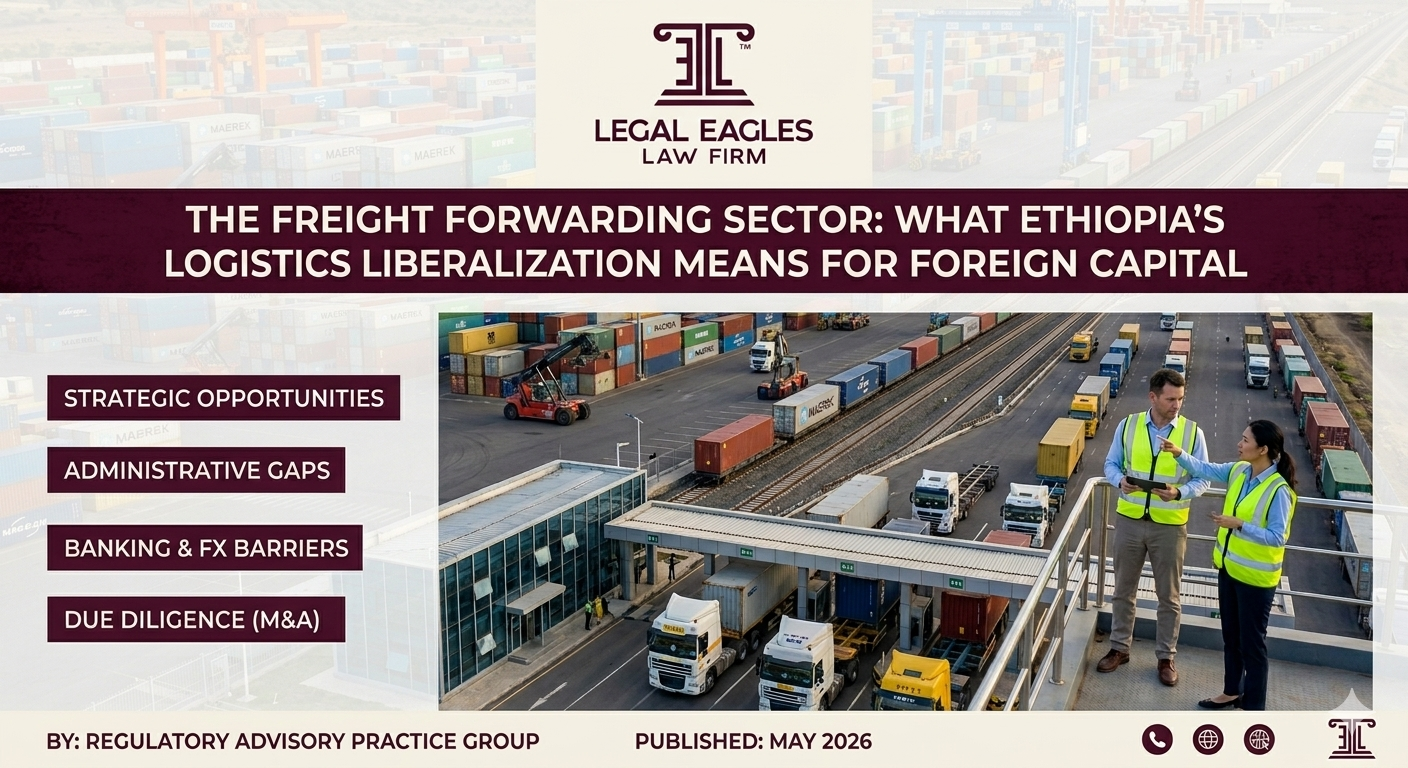
The Freight Forwarding Sector: What Ethiopia’s Logistics Liberalization Means for Foreign Capital
When policymakers open a sector that the state locked down for over thirty years, a dangerous gap opens up between the text of the law and the reality of the bureaucracy.
For decades, advising international clients on entering Ethiopia’s logistics corridor meant delivering a defensive legal reality: you cannot hold the keys. Under Investment Regulation No. 474/2020, the state strictly reserved freight forwarding and shipping agencies for domestic operators, capping foreign equity at a minority 49% stake.
The government has officially dismantled that protective shield. Driven by the Homegrown Economic Reform Agenda (HERA), the Ethiopian Investment Board (EIB) has decoupled the 49% restriction, legalizing 100% foreign equity ownership in the freight forwarding and logistics sector.
However, if you are sitting across from an investment board or drafting a market entry strategy, you cannot rely on headline proclamations. Moving past the polished government press releases, running a logistics practice on the ground right now means navigating a regulatory apparatus trying to catch up with its own laws.
1. The “System Change” Gridlock
The primary bottleneck for entering investors is not the statutory text—it is the administrative software at the ministries.
The Ethiopian Investment Commission (EIC) will smoothly issue an investment permit for a 100% foreign-owned logistics subsidiary. The operational trap springs when you take that permit to the Ministry of Transport and Logistics to secure your mandatory operational competency certificate. The ministry’s internal databases, application workflows, and desk officers still align entirely with the legacy joint-venture system.
Practitioners are routinely encountering administrative delays because the technical registration software literally rejects files that do not include a local partner’s Tax Identification Number (TIN) or a 51% domestic equity allocation. Bypassing this requires formal legal position papers and aggressive administrative pushing to force staff to manually override system fields.
2. The Minimum Capital vs. Asset Requirement Trap
Many entering investors miscalculate the true cost of entry. On paper, the statutory minimum capital required to register a 100% foreign-owned entity is $200,000 USD (or $150,000 USD if partnering with a local firm in a joint venture).
However, that is merely the entry fee to secure a corporate registration certificate. To actually secure a top-tier operational license to move freight, the Ministry of Transport imposes steep, non-monetary asset mandates. Foreign forwarders must prove outright ownership or secure certified long-term leases for heavy-duty trucks, specialized lifting machinery, or substantial bonded warehouse square footage. If an investor thinks they can run a wholly-owned logistics firm out of a laptop from a shared office space in Bole, they are legally and operationally mistaken.
3. Local Banking Realities and Currency Friction
The National Bank of Ethiopia’s transition toward a market-determined exchange rate is a massive win for long-term economic stability, but the immediate transition remains turbulent.
Logistics is a velocity-driven business. Foreign-owned forwarders must constantly remit hard currency to international shipping lines, port authorities in Djibouti, and global airline carriers to release cargo along the corridor. Local commercial banks are still deeply hesitant and slow when clearing high-volume foreign exchange allocations. If local banks place an international forwarder’s subsidiary into a multi-day foreign exchange queue, their containers sit idle at a dry port, accumulating steep demurrage and detention fees that rapidly erode profit margins.
4. The Structural Pivot: Greenfield vs. M&A
Because fighting through the administrative gauntlet to build a brand-new (“greenfield”) logistics operation requires significant time, the actual corporate strategy on the ground has inverted.
Instead of building from scratch, serious foreign direct investment is heavily targeting Mergers & Acquisitions (M&A). Global operators are pursuing mid-sized, existing Ethiopian freight forwarders who already possess clean, valid operational licenses and established physical corridor assets.
Consequently, the role of legal counsel has shifted from basic corporate formation to conducting intense, deep-dive historical due diligence. Entering investors must carefully unravel legacy tax liabilities, carrier risks, and outdated employment contracts that previous management structured under the old currency regime before capital can safely change hands and before counsel can safely structure the target entity into a 100% foreign-owned subsidiary.
The Bottom Line
The total opening of Ethiopia’s logistics corridor is a historic pivot for East African trade, but the gateway is far from seamless. The regulatory framework has shifted focus from “who has permission to own” to “who can execute within the local administrative reality.” For global investors, the opportunity is real, but how well you navigate the technical and bureaucratic undergrowth will entirely dictate the velocity of your market entry.